
My TikTok Shop video went viral, then sales died. Now what?
Why sales stop after a video takes off, what to check first, and how to turn one hit into the next.
It finally happened: a video took off, the orders poured in, and for a few days it felt like you'd cracked it. Then the views slowed, and the sales slowed with them. That rise and fall is completely normal. The good news is that a video that took off once tells you a lot about what to film next.
Why sales drop after a video takes off
- The video ran its course. TikTok shows a video to wave after wave of viewers. Eventually it runs out of new people likely to watch, and views taper off.
- The product sold out. A viral video can empty a shop's stock. If the link shows sold out, the views that are still coming in can't turn into orders.
- The commission or price changed. Sellers sometimes lower the commission or raise the price once a product is selling well.
- A shop ad ended. If part of the surge came from a shop running your video as an ad, sales drop when the ad stops.
- The moment passed. Products have their own waves. Interest in a gadget or a trend fades, even if your video was great.
What to check first
- Open the product from your showcase. Is it in stock? Same price? Same commission? Fix the cheap things first: if another shop sells the same product with stock, that listing can rescue new posts.
- Look at the daily numbers. Did views drop first and sales follow? That's the video running its course. Did sales stop while views held up? That points at the product: stock, price or the link.
- Check for violations. If views stopped suddenly, look at your notifications in TikTok Shop Creator Center in case the video was restricted.
Turn one hit into the next one
A video that took off is the best information you'll get all year. Don't just hope for another; take it apart.
- Write down why it worked. What was in the first two seconds? How did you show the product? What did you say? Was it faceless, a demo, a reaction?
- Film new versions, not reposts. Keep what worked and change one thing: a new opening line, a new setting, a new angle on the same demo. Reposting the same video rarely does as well.
- Move fast. People are still searching for the product while your video is fresh. Follow-ups filmed this week usually beat follow-ups filmed next month.
- Try the same format on a similar product. If a faceless demo sold a cleaning gadget, it might sell the next cleaning gadget too.
How Ollexio helps
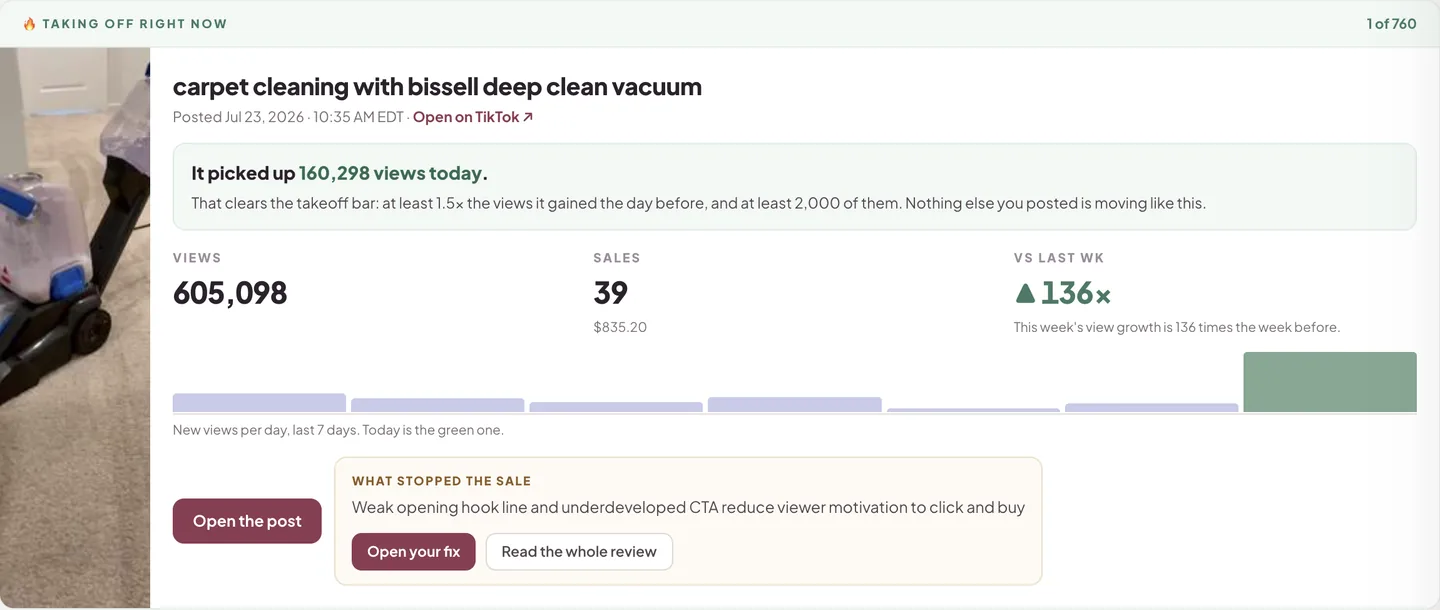
- A "post is taking off" alert when a post starts gaining views much faster than usual, so you can react while it's happening.
- Trending. Which posts are heating up, which are steady, and which get reach without sales.
- Product alerts. A notice when the product goes out of stock, or its price or commission changes.
- Remix in Scripts. New angles built from the post that worked, and AI Review explains what made it work.
Ollexio can't make a video go viral or bring an old one back. It helps you notice sooner and film the follow-up faster.
Questions creators ask
Can I make an old video go viral again?
You can't force it. Sometimes an old video picks up again on its own, for example when a shop puts it in an ad or the product goes on sale. Your best bet is new videos built on what made it work.
Should I repost the same video?
Reposting the exact same video rarely does as well, and duplicate content can work against you. Film a new version: a new opening, setting or angle, with the same core demo.
How soon should I post a follow-up?
While people are still buying the product, so within days rather than weeks. Interest in a product cools, even when the video was great.